I attended an “industry event” last week. In conversations over coffee I learnt that BT has a social media policy that is 32 pages in length, and written in pure legalese: “the party in the fist part” etc.
Whereas Zappos‘ social media policy is “be real and use your judgement”.
Guess which company is renown for great customer care, and which one isn’t.
I don’t like or normally use the term “monetise”, but it is the big question hanging over Twitter; how are they gonna make money from this thing?
We saw last week that Twitter have secured another found of funding described as “significant”, and so we assume that at some point these investors are going to want to see a return.
Many ideas for how Twitter might monetise the service have been put forward: paid accounts, premium accounts for brands and companies, advertising on the page, advertising in Tweets etc. But I have another thought about how Twitter might be planning to integrate advertising or paid content.
In the sidebar of the of a Twitter user’s homepage is a trending topics panel which shows the topics, keywords or hashtags being tweeted about most at that point in time. Clicking on one of these takes you to a search for that term or keywords which can be updated as new tweets appear.
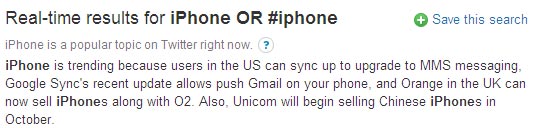
Clicking on the trending topic ‘iPhone’ this morning I went to the usual list of tweets but then noticed this new, at least to me, content at the top explaining why ‘iPhone’ was a trending topic:
I’d not really got why Twitter had added trending topics to the site as it just seemed to be a tool for spammers to piggy back upon, but once you see this explanatory content it starts to make a little more sense. I can see this easily becoming advertising (Google keywords anybody?) or paid for content: each use of the word iPhone could be a link to Apple.com for example. This would allow Twitter to start to generate revenue from the service and without a negative impact on the user experience. Interesting…
Of course this would make trending topics even more of a spam magnet and doesn’t address the large number of users accessing Twitter via other clients and applications, but it does point to a potential approach for Twitter to start making money.
Neither party accepted any liability. In light of this amicable agreement, Psion has agreed to waive all its rights against third parties in respect of past, current or future use of the ‘Netbook’ term.
I don’t know what deal was done, but I don’t feel that this rather grubby episode has done anything but tarnish Psion’s already diminishing reputation. Shame.
I realise that Dell and Intel’s motives are purely commercial, but I dislike the patent and trademark litigation culture that has grown alongside the technology industry. I agree wholeheartedly that companies ideas and designs should be protected but only when their claims are real and genuine.
I would have thought more of Psion had they contested the netbook trademark as soon as it started being applied to the new generation of netbooks. Instead they waited for it to become thoroughly embedded before doing so. I would have though even more of them if they had released an updated version of the netBook.

 I don’t like or normally use the term “monetise”, but it is the big question hanging over